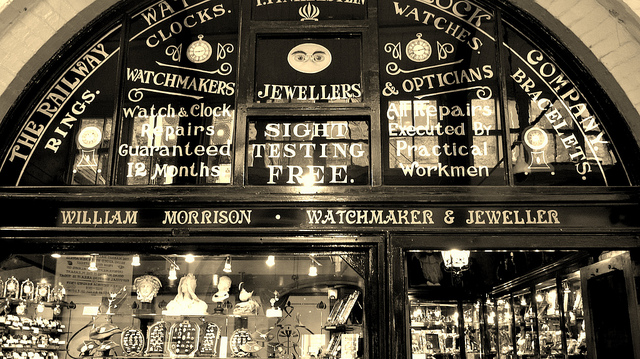
A ghost story for Christmas

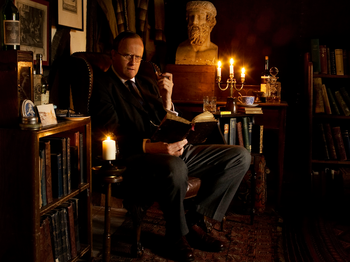
8574751394_b5b92b4dc1_z

Photo by Karen Sheard on Flickr

The Watchmaker’s Gift

I returned from midnight Mass eager for the warmth of my master’s hearth and something indulgent to drink. I had enjoyed the Christmas service, on the whole, but I was saddened my master was too unwell to accompany me as he had for many years. I was a small boy when he selected me as an apprentice, appreciating the slender dexterity of my fingers, naturally suited to the intricate arts of the watchmaker. Since then, his astounding miniature creations had earned us both considerable fame – timepieces no bigger than buttons, working clocks for dolls’ houses, and even a jewelled ring that chimed on the hour and was rumoured to have been purchased for a Russian princess. With his advancing age, my master’s mounting obsession to create the tiniest watch imaginable had claimed his eyesight. Now, even with his thick spectacles, he struggled to see so much as his own knife and fork when I served him supper. It pained him, and at church that Christmas Eve I said a prayer to all the saints I knew:

“Return my master’s sight to him, even just for the night. Help him craft one more tiny, wondrous thing.”

When I returned to our home above the workshop, I found only one candle lit beside our diminutive Christmas tree. My master sat in the gloom. I could barely ascertain the glint of his spectacles. The dark was bad for his eyes and the cold bad for his chest, but I hadn’t the heart to scold him, particularly when I noticed, next to the tree, an enormous box. It was wrapped in red paper and sealed with a ribbon of gold, and was almost as tall as me. It had not been there when I left.

“A small token, dear boy,” I heard my master say, from the shadows. “Unwrap it, please. It is past midnight, after all.”

With a glimmer of childish pleasure, I set about opening my gift. As I tore through the red paper, thinking I would find some large wooden chest or armchair, I was surprised to find neither of these things, but another layer of wrapping.

“Smaller,” he chuckled. I smiled, heartened by the return of my master’s good humour, and continued to unwrap my gift. Yet I found only another layer of paper.

“Smaller,” said my master.

After some time and much bemusement, I was surrounded by mounds of discarded red paper. The package had shrunk to the size of a shoebox, but I was no closer to my gift.

“This must have taken you hours to wrap,” I laughed. How had he hidden something so large from me? Our workshop was modest, our rooms above intimate. I knew of no-one with sufficient humour to help him in such a task. I was the only family the old man had.

“Smaller,” my master coaxed from the darkness.

Dawn approached. My head swam with my need to sleep, and the gift, still neatly wrapped, was now small enough to hold in my palm. I was irritated with him, and annoyed at my own pettiness in the face of such an elaborate and no doubt well-intentioned joke, but still I tore through layer upon layer of paper and ribbon. My fingertips grew sore. My eyes ached with the lack of light, and for another hour the only sounds in the room were the tearing of paper and the soft, infuriating laughter of my master.

“Smaller.”

When the gift was the size of my thumbnail, I thought that surely, at last, I was close. It would be one of his miniature timepieces, the smallest yet, a wonder of the age. My prayer would have been answered. We would share a brandy and chuckle at my astonishment, and in the light of Christmas Morning we would eat fruitcake and play cards as we had together since I was a boy.

Yet as I peeled back the final layer of paper, no bigger than a postage stamp, I found the package to contain nothing.

At first, I simply stared. My hands shook. There was no miniature timepiece, no gift, not even so much as a grain of rice for my labours. And my master, not a cruel man, not a man given to spiteful gestures, was laughing in his chair, in the corner, in the darkness. Laughing at me.

I snatched up the candlestick and strode with it to his chair to demand an explanation, to touch his brow for signs of sickness, or worse, some brain fever brought on by frustration and old age. I lifted the candle above my head to better view him and was about to open my mouth, unable to contain my annoyance any longer.

He had, for some considerable time, been dead.

Christmas: A Survival Guide For The Spooky

Every year, around September, the nightmares start. I’ve lost the ability to cook, or forgotten to buy presents, or – and I had this one last night – a completely imaginary cousin is having a breakdown over the sprouts because he can’t afford to move out of his parents’ house and what are you going to do about it, Verity?!

Wading through the syrupy supermarket ads, the money-grabbing pop songs, and all that infernal fruitcake, we’ve forgotten that midwinter was once a time for ghost stories, when our ancestors met around the fire to celebrate another year of narrowly avoiding the bloody flux. All that phoney Christmas cheer can be hard when you’re spooky by nature, so I’ve put together a list of things that might just get you through…

Printer’s Devil Court by Susan Hill

Misty winter evenings, strong drink, and Victorian medical students with too much time on their hands. It’s a pocket-size ghostly novella that can be read in one sitting, and the punchline is Susan Hill at her effortlessly chilling best.

M.R. James’ ghost stories by Nunkie Theatre

nunkieI’ve seen Robert Lloyd Parry read James’ tales of the uncanny twice, in the flesh – in a candlelit medieval leper chapel, no less. Parry’s softly-spoken delivery casts you back into an antiquarian age of fusty academics and sherry sipped alone by the fire. He is the next best thing to re-animating the author. You can buy DVDs and audio here.

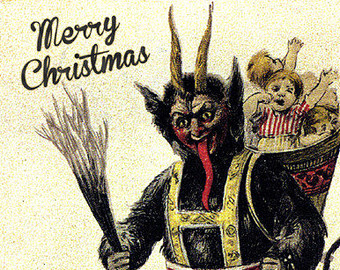
Krampus

krampussticksIf you’ve ever worked Christmas in retail, you’ll understand the appeal of a giant Germanic goat-man dragging naughty children away in chains. Krampus has enjoyed something of a Renaissance in recent years, so it’s no longer hard to source hilariously macabre cards, ornaments, and festive jumpers bearing his grinning hairy visage. My own tree features a glass Krampus nestling amongst bat tinsel.

Christopher Lee’s heavy metal Christmas singles

Thrashing as we go
In a hearse that knows the way
To hell we go!
Crying all the way.

“It’s light-hearted, joyful and fun,” he says. Thank God for Christopher Lee. His own Christmas tradition involves wearing Vincent Price’s special festive hat.

The Haunted Looking Glass

Selected and illustrated by Edward Gorey, this is one of my favourite collections of ghost stories. Highlights include Dickens’ ‘The Signalman’, and Stoker’s ‘The Judge’s House’. Small enough to produce from your handbag during those hellish Post Office queues.

Jill Tracy – Silver Smoke, Star of Night

Because nothing fosters that festive glow in the heart like the minor chords of murky cabaret. Jill Tracy’s voice is silk and cyanide. Her Christmas album features gloomy renditions of traditional carols as well as ‘Room 19’: “Tracy’s tale about the forlorn spirit who haunts a desolate hotel room where he committed suicide Christmas Eve 1947”.

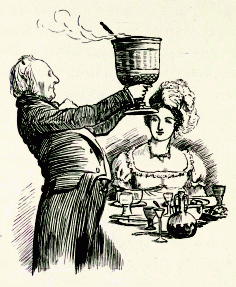
Charles Dickens’ hot gin punch

ginpunchI sampled one or two of these at the recent London Month of The Dead, courtesy of Hendrick’s Gin and inspired by Mister Micawber…

I never saw a man so thoroughly enjoy himself amid the fragrance of lemon-peel and sugar, the odour of burning spirit, and the steam of boiling water, as Mr Micawber did that afternoon. It was wonderful to see his face shining at us out of a thin cloud of these delicate fumes, as he stirred, and mixed, and tasted, and looked as if he were making, instead of a punch, a fortune for his family down to the latest posterity.

Gin lovers disagree on the finer points, but go ahead and experiment with the basic elements: gin, Madeira, lemon juice, sugar, spices, and boiling water. For a more authentic Victorian taste, perhaps swap dry gin for the harder flavour of Dutch genever. Punch doesn’t have to be cosy; simply don a black veil and sit in a corner, a la Lady Dedlock, and brood over the intoxicating vapours.

There. Doesn’t that feel better? Merry bleedin’ Christmas. And roll on next Halloween.

07638_Xmas_Witch_1_1000_122_131lo

Review: Silent Partners at The Fitzwilliam

It’s been a good couple of months for writing. After getting some lovely responses over my last short story (it’s been nominated for the Pushcart Prize – I got the news in the middle of the night during a bout of chronic pain, and I initially thought it was my medication playing tricks) I’ve been putting concerted effort into finishing the novella that’s been lingering about since last winter. To be annoyingly vague, it concerns the nocturnal lives of mannequins, so, for a bit of research and a break from my desk, I visited Silent Partners at Cambridge’s Fitzwilliam Museum.

Reposing, by Alan Beeton

“Silent Partners is a ground-breaking exhibition devoted to the artist’s mannequin, that uncovers its playful, uncanny – and sometimes disturbing – history from the Renaissance to the present-day.”

The exhibition is far bigger than I anticipated. Three large rooms of artists’ lay figures, anatomists’ models, and fashion clotheshorses charting the evolution of the human simulacrum from religious devotion to arch Surrealism, along with striking photography and disembodied limbs dotted around the rest of the Fitz.

Life-sized dolls, no matter how beautifully made, are creepy, and the curators understand. From the moment you enter Silent Partners, you’re hit by the ‘uncanny valley’ effect. Viewing Walter Sickert’s life-sized wooden lay figure – laid out in a coffin, no less – I realised I was experiencing the same sensation of voyeurism I get when viewing Egyptian mummies or one of Doctor Gunther’s anonymous corpses. CT scans add to that sense of the uncanny. The mannequins once had life and purpose. Now they lie still.

To my perverse delight, the Fitz has sourced one of Thomas Edison’s horrendous talking dolls. It’s about as adorable as a vocal manifestation in a poltergeist haunting. The business went bust in the 1890s because children were understandably terrified. Dolls – blonde and smiling or otherwise – have the power to scare, whether you want them to or not.

Are you still with me after that?

Less unnerving is the lay figure’s role as studio companion. Many of the nineteenth century mannequins on display have small, faintly smiling faces and eyes that look submissively up from under the lashes as if to say, “…master?” This of course led to accusations of fetishism – a new term in fin-de-siecle psychology. After all, an artist’s lay figure is an idealised, usually female figure, posable, silent, and always there. A kind of sexless mistress, lifelike but lifeless.

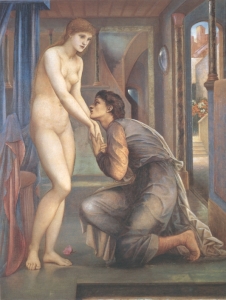
Edward Burne-Jones bears the brunt of this. Comparing his Pygmalion series to the vibrant new woman of Jones’ time, one label points to Ned’s fixation with statue-serene models as a symptom of his own sexual repression. That strikes me as a bit harsh, particularly when looking at his famously fiery lover, Maria Zambaco. You don’t roll around on the cobblestones with someone if you’re not at least slightly open to the urgency of your own passions. But I see what they’re getting at: ‘I love you, but please stand still and shut up’.

The_Soul_AttainsThere’s a surprising amount of Pre-Raphaelite art, considering the movement was so concerned with realism. Ford Madox Brown owned five lay figures at the time of his death (including a horse), and The Last of England was completed partially with the help of these figures. Critics noticed. There’s a fun insult from the eighteenth century: “This painting stinks of the mannequin”. Millais was better at hiding his use of lay figures. The Black Brunswicker required two so that the models – Dickens’ daughter Katy and an army private not of her acquaintance – wouldn’t have to hold such an intimate pose.
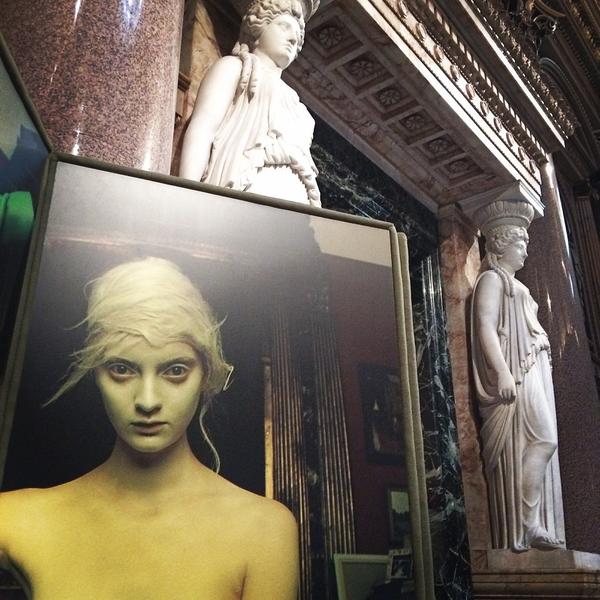
The fashion segment was particularly interesting. Earlier clothes modelling mannequins have far more physical agency than the ones you’ll see in Topshop windows. These eighteenth century lifeless girls have hands that reach and gesticulate, and faces poised as if to speak. It was only in the nineteenth century that shop windows began to display disembodied hips and busts. A decline in tailoring to the individual? Or a less sinister preference for cheap mass production?

Overall, Silent Partners is an impressive undertaking and hugely interesting – and free! I’ll be returning at least once. The only downside was the lack of labels on the large photographs dotted around the other galleries, because I loved them but couldn’t find the photographer’s name. It’s probably my shortsightedness, but somebody enlighten me, please.

Photo by StuffandStories on Twitter.

Photo by StuffandStories on Twitter.

Silent Partners is on at the Fitzwilliam Museum of Cambridge until the 25th Jan 2015, and then the Musée Bourdelle in Paris from the 31st March until the 12th of July 2015.

That Damned Elusive Pearl Spiral

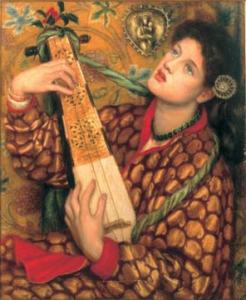
You will have seen it again and again in Rossetti’s paintings of lush, isolated women – a spiral of pearls nestling in waves of red or raven hair. Once you’ve noticed it, it keeps turning up. Here it is in ‘A Christmas Carol’…

christmas-carol…and in Alexa Wilding’s hair in ‘Monna Vanna’…

dante_gabriel_rossetti_12_monna_vanna…and, naturally, adorning Jane Morris in ‘Mariana’…
mariana
Rossetti was an incorrigible collector. His Chelsea house was crammed with musical instruments he never played, mirrors he never polished, and great swathes of fabrics for the beautification of his models. He spent the evenings rummaging in junk shops for exotic jewellery and amassed quite a collection of cheap yet dramatic pieces. Some of these pieces still surface in Pre-Raphaelite and Aesthetic exhibitions. Unfortunately, the spiral hair pin he obviously adored was allegedly borrowed by a friend and never seen again. That probably didn’t do Rossetti’s latent paranoia any good.

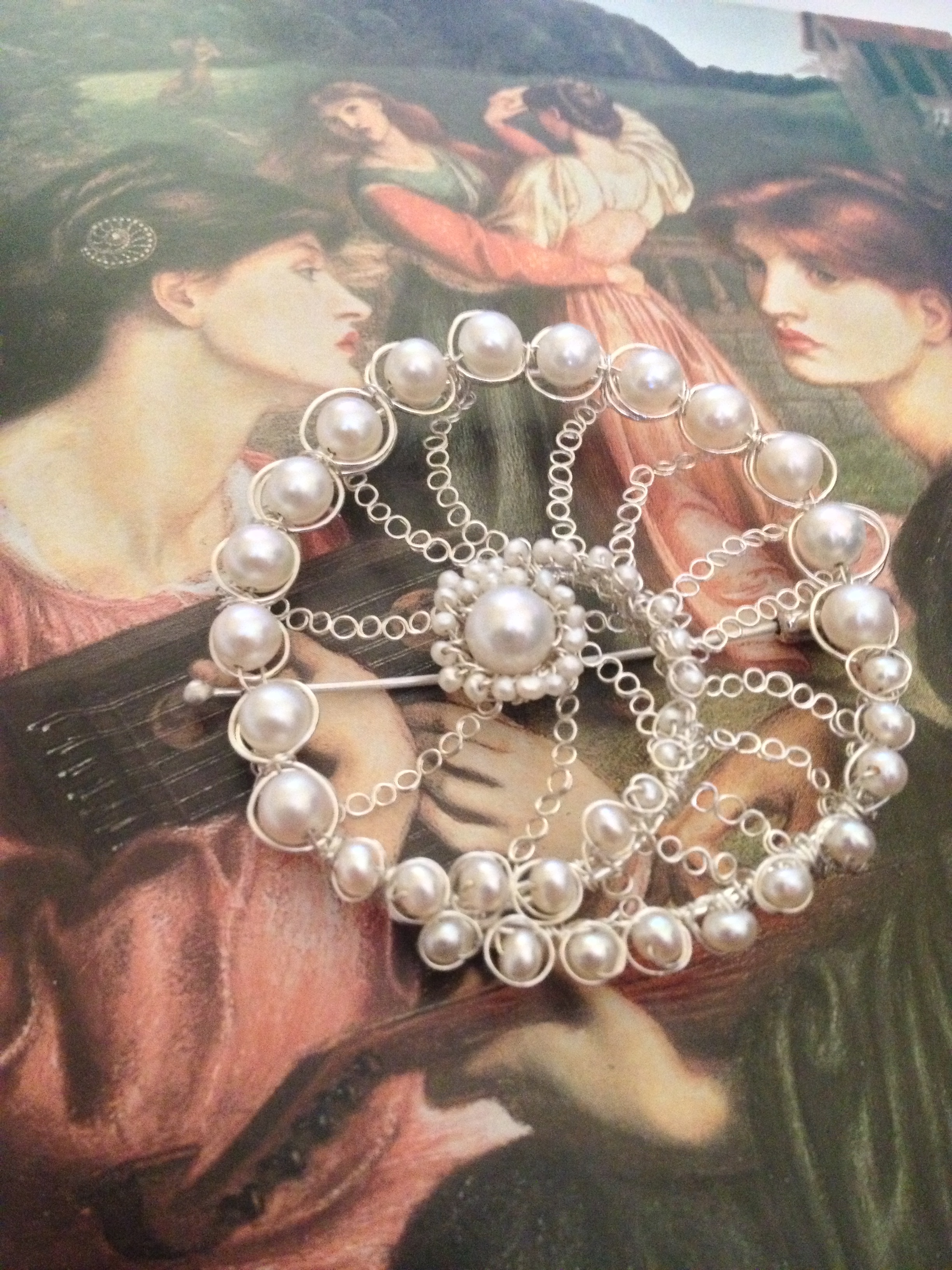
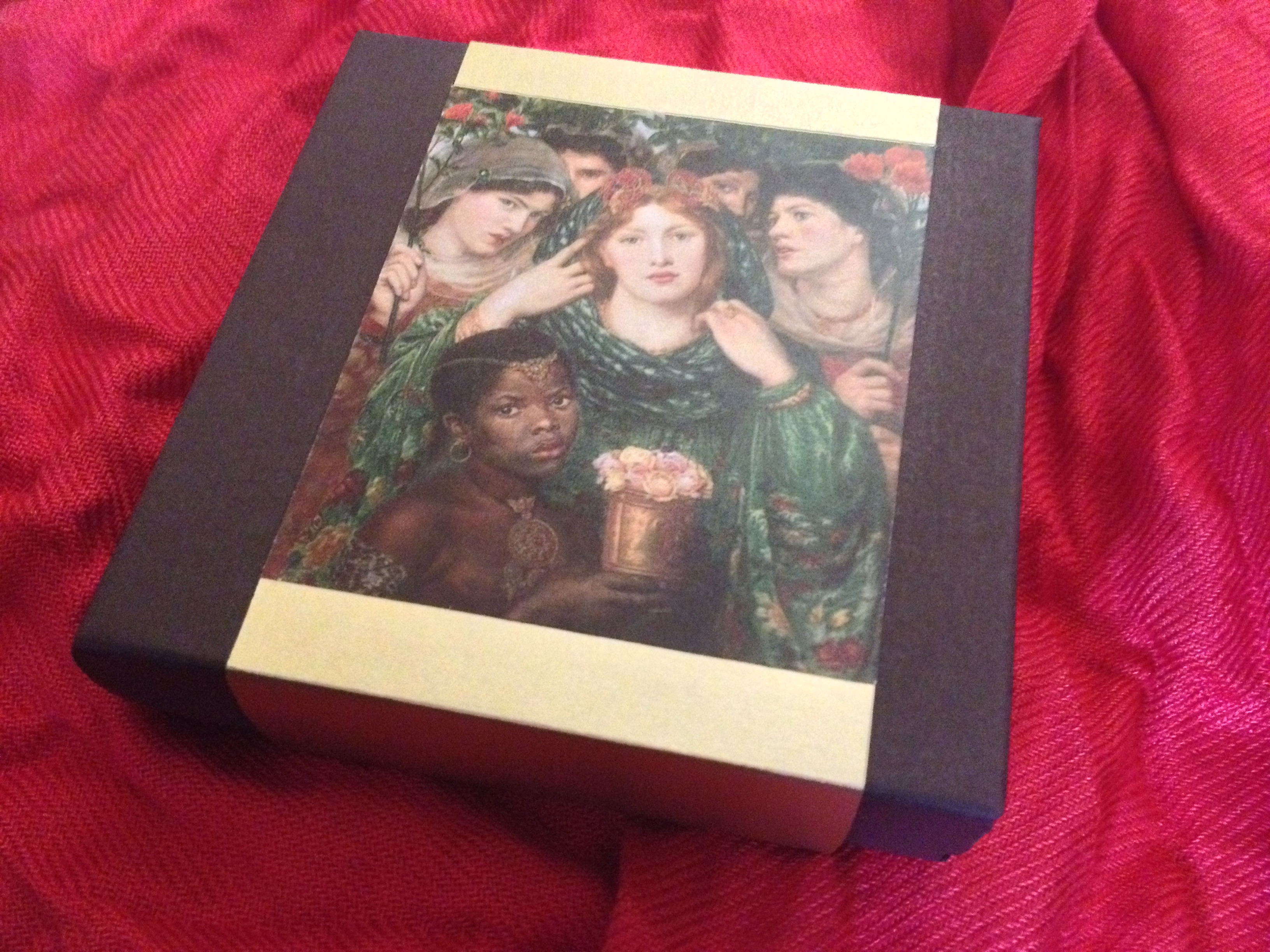
While we wait for it to turn up on Antiques Roadshow, we have Kirsty Walker’s biscuit replicas to enjoy, and – at last! – beautiful handmade replicas by Joanna of Nanya Online. I don’t normally do plugs, but I won Joanna’s Tumblr competition and I’m just thrilled. It arrived today in a tiddy box adorned with ‘The Beloved’.

IMG_2672 IMG_2678Isn’t it delicate? It feels like a network of tiny bones in my hand. Joanna also makes earring replicas of the spiral. Have a look at her shop.

Unlike Alexa Wilding and friends, my hair is made of ghosts, so nothing will ever stay in it. Luckily the spiral comes with another pin so it can be worn as a brooch. I’ll be wearing it on my Victorian riding jacket at Portsmouth’s Victorian Festival of Christmas where I’ll be ‘performing’ – ha! – later this month. See you there.

Terror & Wonder: The Gothic Imagination at the British Library

gothbl I’d like to be able to write coherently about the British Library’s Gothic exhibition, but because I’m an inveterate goth, I’m at risk of listing my moments of “Oh God, I can’t believe they’ve got the actual original [insert artefact here]”, hand to pale brow. Bear me for a moment, because–
Mervyn Peake’s handwritten Gormenghast!

Doctor Dee’s Elizabethan scrying mirror!

Thomas Chatterton’s medieval forgeries!

Letters by John Polidori!

Not since 2012’s Pre-Raphaelites at The Tate have there been so many of my favourite things in a single room. Anyone who loves Gothic will lick their chops at The British Library. From the genre’s florid beginnings with The Castle of Otranto to The Sisters of Mercy crooning at girls who wander by mistake, the exhibition is a celebration of the pleasure Gothic’s many incarnations have brought people down the centuries – and how Gothic manages never to die.

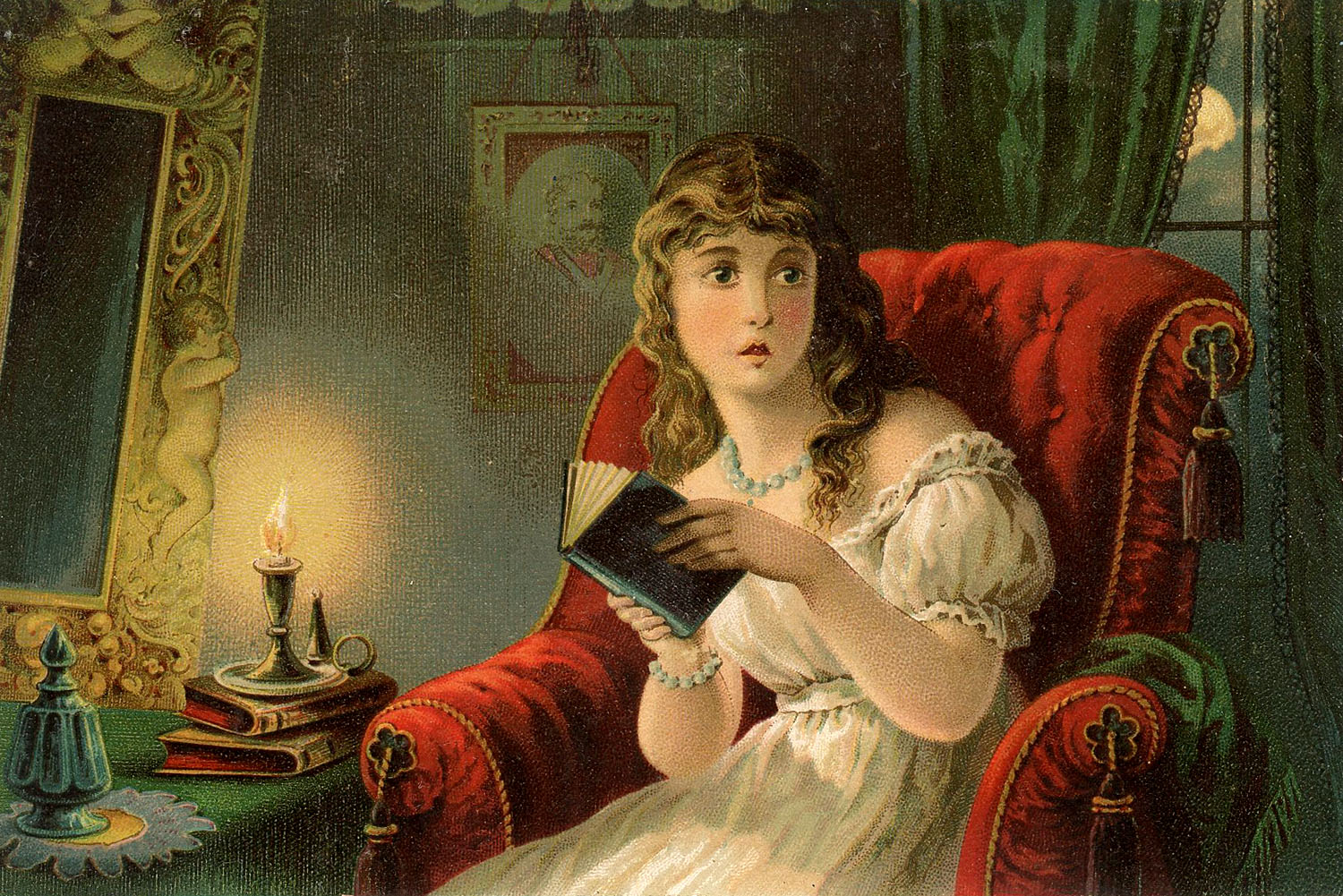
Crumbling ramparts, impenetrable forests, double lives, and lashings of gore. Gothic has always toyed with what disturbs us – the secret lives of respectable personages in Dr Jekyll and Mr Hyde, female sexuality in Carmilla, foreign invasion in Dracula. No wonder there was pearl-clutching at the thought of sensible Victorian girls devouring Gothic novels, letting their darkest desires run free. This breathless consumption of all things dreadful left early Gothic fans open to ridicule (try reading The Castle of Otranto without laughing), but the exhibition manages to convey Gothic’s steady evolution into a self-aware, perhaps even post-modern genre, taking us through to Edward Gorey’s playful macabre and the androgynous world of post-punk goth.

gothicnovels

The hysterical quality of Gothic is where the fun lies. Because there’s that veneer of ‘wink-wink, we know this is daft’, the genre has the opportunity to introduce genuinely scary ideas in a setting we’re already comfortable with. We sign up to the horror of Gothic while we may shy away from brutal realism. Take the alcoholism and child abuse in The Shining. We talk about the bathtub woman or the bloody lift, but what’s really chilling is Jack’s likability while he terrorises his wife and child with a croquet mallet. Gothic is something that lurks beneath the ordinary; a sense of heightened, oversaturated reality where the family secrets are literally locked in the attic, scratching with broken fingernails at all that floral Victorian wallpaper.

Terror & Wonder is on at the British Library until January 2015.

Cake or Death? Sin-eating and other morbid confectionary

My short story, Cremating Imelda, is published in Animal Literary Magazine this month. Imelda, a modern hermit in an abandoned village on the Norfolk coast, is a woman with a morbid talent concerning food – and mortal sin.

This is an old fascination of mine: the links between death, what we eat, and why.

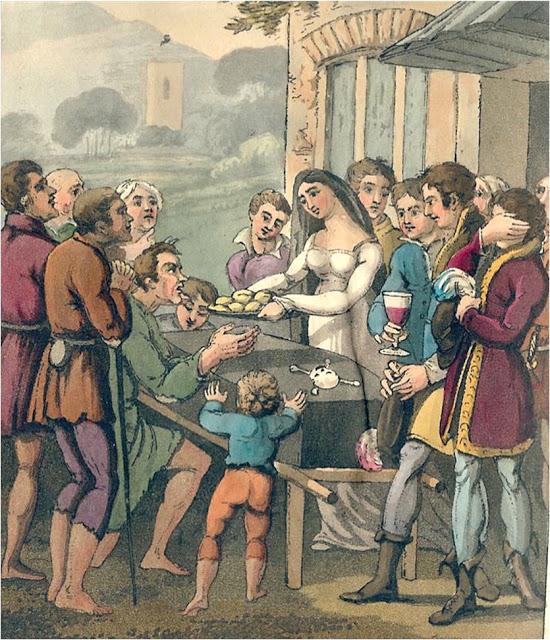
For centuries, sin-eating was a funerary tradition grudgingly tolerated by The Church. Usually a reviled individual on the edge of society, the sin-eater went to funerals and ate bread or cake off the coffin, absorbing the deceased’s sins and thus allowing them to speed through purgatory. Presumably, they hoped someone would do the same for them, when the time came.

sin-eater

Sin-eating has long fallen out of favour. But there are more recent funerary traditions involving food that still manage to make us uncomfortable. A childhood memory: a Greek holiday. I was permitted one treat; anything I chose from the bakery. This bakery was nothing like the ones in England. There wasn’t a single stodgy pink bun or unhappy gingerbread man. Every confection was a miniature ornament sprinkled with green pistachio, or shining with honey. But what I wanted was inside a glass cabinet. A dish piled with plain brown biscuits. Just flat brown rounds of dough – nothing to excite a child. Perhaps it was because they were behind glass and therefore forbidden. I knew what I wanted, and I asked for it.

“Those are not for little girls. Those are for… for…” The baker wheeled her hands, searching for the English. “The funeral.”

funeralbiscuit

Get the child away from the death biscuits. This was a Greek custom, the baker told us. Sweets to eat in the presence of the dead. Looking at the mountain of biscuits, I remember thinking the locals must have been dropping like flies. I ended up with some unmemorable cake or other, and the episode went down as further proof that Verity always was ‘a grimly kid’ (to borrow Rossetti’s phrase). But the idea of funeral biscuits fascinated me. Why didn’t we do this in England?

Food has become the awkward aftermath of the funeral service. I find myself in church hall kitchenettes, spending a great deal of time nibbling dismal supermarket own-brand Jammie Dodgers because it gets me out of talking to anyone. I’ve already stipulated I want gin served at my funeral, partly because everyone secretly hates those undersized cafeteria cups of tea, and also because I think a funeral is a place for a sort of human communion. “Take, eat: this is my body, which is broken for you: this do in remembrance of me.”

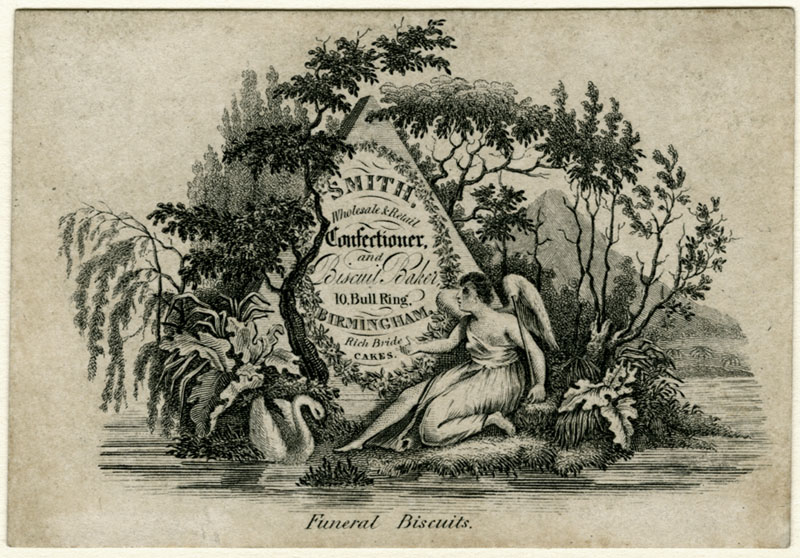
Trade card for Smith, Wholesale and Retail Confectioner

The Nourishing Death blog is a brilliant resource for anyone interested in the ways people all over the world honour their dead with food. Because food, in a ritual setting, is communication. In Funeral Festivals in America, Jacqueline S. Thursby writes of the funeral biscuit’s role in the Victorian way of death in the USA’s Pennsylvania:

…a prevailing funeral custom was that a young man and young woman would stand on either side of a path that led from the church house to the cemetery. The young woman held a tray of funeral biscuits and sweet cakes; the young man carried a tray of spirits and a cup. As mourners passed by, they received a sweet from the maiden and a sip of spirits from the cup furnished by the young man. A secular communion of sorts, these were ritual behaviors that transcended countries of origin and melded a diverse young nation with the common cords of death, mourning, and tradition. The funeral biscuit served as part of a code representing understood messages of mourning, honor, and remembrance.

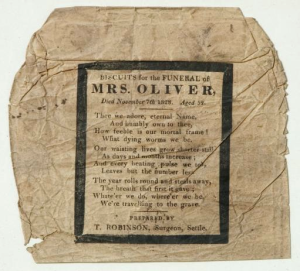
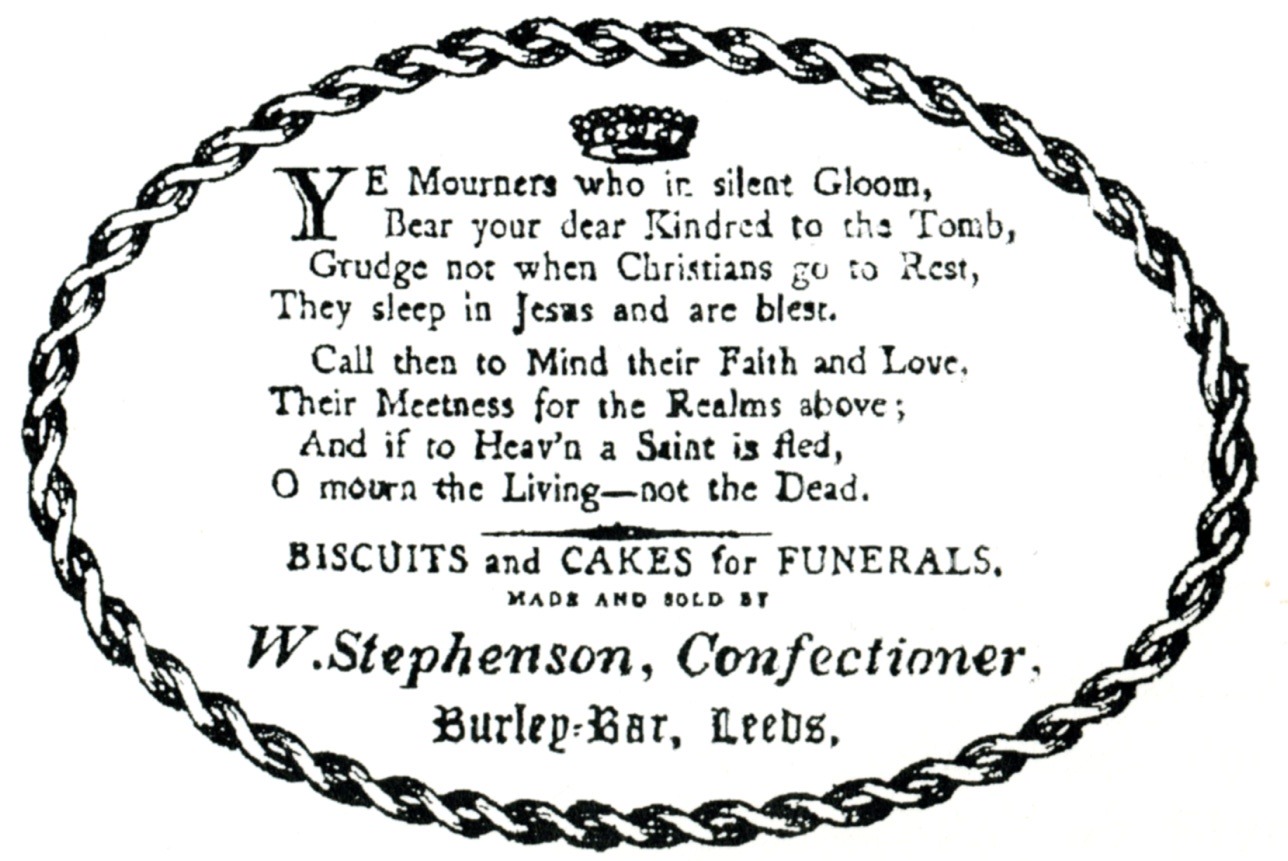
Screen Shot 2014-09-26 at 13.25.49In England, packaged up in paper and sealed with a blob of black wax, funeral biscuits came in many different flavours and shapes. Sometimes the packages bore morbid little poems, practically gallows ballads. One of these is in the Pitt Rivers museum. Biscuits for the funeral of Mrs Oliver, died November 7th 1828, aged 52:

Thee we adore, eternal Name,
And humbly own to thee,
How feeble is our mortal frame!
What dying worms we be.

All flesh is grass. Enjoy your biscuit.

It’s little wonder such unflinching morbidity is unwelcome in the sanitised funerals of the modern world. But many European cultures still hold on to the funeral biscuit. In 2011, a Greek family were accidentally fed cocaine-sprinkled funeral biscuits, leading to what sounds like a lovely service:

The elderly bystanders, instead of mourning, began to dance around the dead, and the tears turned to nervous laughter. The cognac was consumed in shots accompanied by the sound of happy toasts, and there were some who started ordering mojito cocktails.

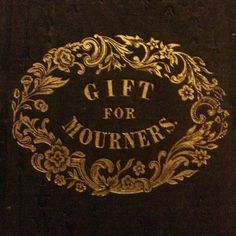
giftformourners

So what do you have planned for your send-off? If you could have a sin-eater come to wipe away your deeds, would you?

New readables

My short story, Cremating Imelda, is the featured story in this month’s Animal Literary Magazine. When Imelda’s 440lb body overwhelms a crematorium’s ventilation system, the newspapers are equally horrified and amused. But Imelda had a life before her cremation, and a secret talent only her parish priest was privy to.

Also out soon in the Pre-Raphaelite Society Review is my article ‘In Defence of Walter Deverell’. Sometimes referred to as the ‘lost’ Pre-Raphaelite, Deverell died before his talent could truly take off. What happened to his family – and how they kept Walter’s place in PRB history alive – was interesting and poignant to research. Some typically bitchy Victorian letter-writing, too, with what appears to be the use of some rather sneaky pseudonyms.

The Heartbeat at My Feet

By now, you’ll have heard the appalling news about the Manchester Dogs’ Home fire. Though the temptation is to detail the circle of Hell I’d dearly love the arsonist to languish in for all eternity, I’d rather focus on the good that can be done for the dogs who survived. Over a million pounds have been donated by the public so far, on top of food, beds, and toys (you can donate here if you haven’t already). All these dogs and more need loving homes, so to prove how fantastic a ‘second-hand’ dog can be, allow me to introduce my rescue dog, Brontë…

bronteonthesofa2

I’ve wanted a rescue dog for years. What I didn’t realise was that I’d end up physically doing the rescuing.

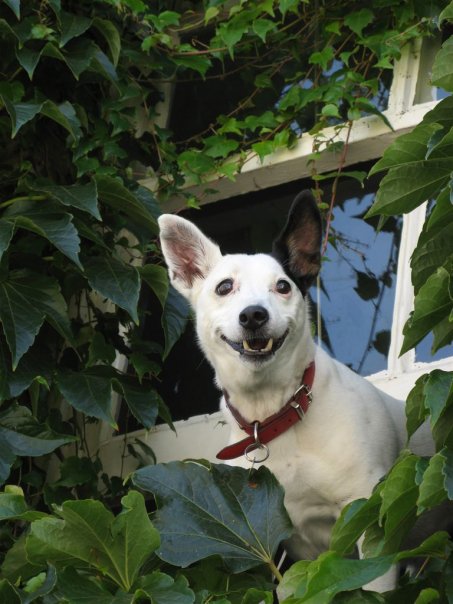
A bit of background. My childhood dog, Bobby, was basically my brother. I wrote comics about him, fashioned miniature Bobby adventure novels out of cereal boxes, and set up a fan club. With over fifty members in my Primary school alone, he was possibly the most celebrated Jack Russell in 1990s Suffolk. This was the dog who once leapt out of a window to hijack a Royal Mail van (postman was unharmed) and defiantly trampled the hallowed lawn of Kings College one snowy Christmas Day. He was irreplaceable, but I always knew I wanted another dog after him, especially one who needed a bit of help.

dadbobbyhowldadbobbygrin

You know that story about how Neil Gaiman found his beautiful white husky by the side of the freeway? This summer was my turn. Driving through the countryside with my dad on a simmering hot day, we had about four seconds to realise a four-legged muddy thing was rocketing towards us out of the heat-haze and that it had no intention of avoiding us. We opened the car door and she threw herself in.

I later joked the sight of her galloping down the tarmac was like the Black Beauty title sequence, but she really was majestic. A long-legged grinning wolf with a foxy tail and black-rimmed yellow topaz eyes.

Up close, it was a different story. She was bony, thirsty, and riddled with fleas. No i.d., just a godawful Paris Hilton-style collar, the leather torn and frayed where she’d been fighting a tether. We later learned she’d been locked in a caravan on one of the hottest days of the year, alone, for hours. Had she not forced her way out, she could well be dead.

Long story short, her owners were happy for us to adopt her. We named her Brontë, because we found her Wuthering.

bronteonthesofa

We bathed her, treated her parasites, got her to eat. It wasn’t an instant transformation. You’d throw a tennis ball and she’d morosely watch it bounce away. She would follow me from room to room, silently, avoiding eye contact. Move too quickly, and she’d flinch. Once, when I left the house, she attempted to squeeze her way out of a first floor window to follow me.

It’s been two months. The vet says she’s almost an ideal weight. She loves to meet strangers and let them tell her what a big, bad, beautiful wolf she is. Toys are no longer a mystery, and she’s beginning to respond favourably to that arcane primate ritual, the hug. And bones. So many delicious bones. We love her. We love our life with her. She’s a troublesome beast, and we wouldn’t be without her.

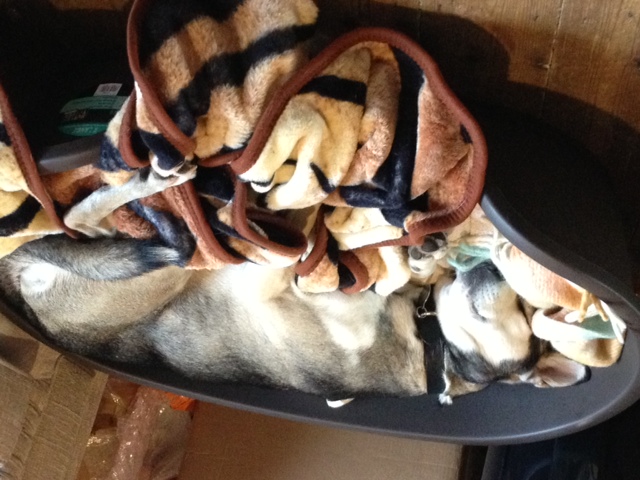
brontesnooze

Adopt a rescue dog. With rescue dogs, you enjoy the satisfaction of taking on a creature who needs your help and seeing it improve day by day as a direct result of your kindness. Adopt a rambunctious terrier. Adopt an old lapdog. Adopt a wee beastie rescued from a puppy-farm cage. If it’s a pup you want, register your interest at your local shelter, and they’ll contact you when a litter comes up. When you adopt a dog from a shelter, you make the choice to take business away from unscrupulous breeders, puppy farmers, illegal importers, and other assorted lowlife. Those people deserve every blow that’s coming to them, and dogs deserve all the very best humans have to give.

“My little dog—a heartbeat at my feet.” – Edith Wharton.

A Sense of Place

I find I’m writing more and more about a sense of place. I’m moving house this week, and all my notes are about waterways, familiar food, and the colour of soil.

I was born on the Rock of Gibraltar. My Dad was stationed at the Navy base there, and I spent the first two years of my life beautifully oblivious to the existence of England and drizzle and Margaret Thatcher. I went back last month, not for the first time. As usual, didn’t want to return.

As a Forces child, going wherever the MOD tells you to while the head of your family sweats in a minesweeper’s engine room somewhere far-off and unpronounceable, you’re left feeling like you belong nowhere. Family interactions take place via satellite phone, friendships are brief, and your birthday plans depend on what Saddam Hussein and Slobodan Miloševic have in store for June. Though I left Gibraltar in the late ’80s, the place always meant more to me than anywhere that followed. Two years after Gib, we were on a godawful submarine base in Scotland. Our allotted house had been arsoned a few months previously. Shards of glass, all over the garden.

The Rock was stable, I was safe there, and it was mine. Nulli Expugnabilis Hosti.

IMG_2051

plane hibiscusskull

Gib is dusty and colourful and intimate and huge, and every time I get off the plane and crane my neck to see the gulls wheeling around the harsh green crags of the upper Rock, I wonder why I ever let myself get mired in the flat Fens – though I love those, too.

It’s the abundance of light and water.

IMG_2037europa

IMG_2126IMG_2061

Plus, you can buy a litre of vodka for £3.99. If that were the case in Britain, you’d be stepping over mounds of poisoned teenagers, but the closest I got to an encounter with a drunk was a sober gentleman carrying an easel, wanting to tell me something important:

“You’ve changed your dress. You were wearing black this morning. I saw you, wearing black. I had a demon inside me for fourteen years. But I met a man from Birmingham, and he made it come out of my neck, like whoosh.”

ritaP10400956

mary

saint1


I find it’s only after you leave a place that you begin to feel it inside you.